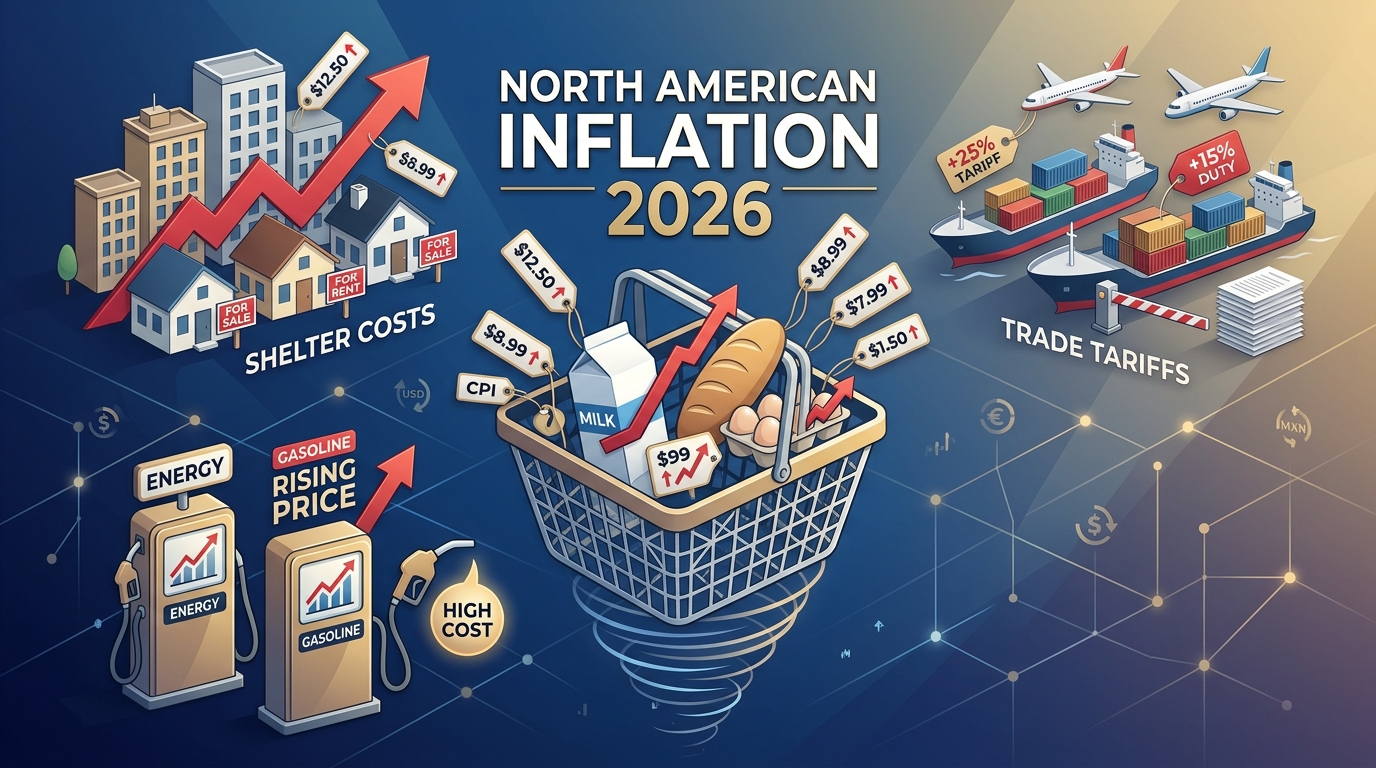
For millions of families across the United States and Canada, walking down the grocery aisle, refueling at the pump, or opening a monthly housing statement in 2026 continues to prompt a familiar sense of financial pressure. While headline inflation has receded from the historic high points seen earlier in the decade, consumer price growth remains stubbornly sticky—hovering in the 2.8% to 3.4% range across North America. To everyday consumers, the question remains pressing:why do costs continue to rise, and what structural forces are driving inflation in 2026?
Understanding today’s economic climate requires looking beyond simple monetary explanations. Inflation in 2026 is driven by a combination of ongoing housing supply shortages, delayed international trade tariffs, energy market volatility, persistent service-sector wage growth, and massive capital investments required for clean energy transitions and artificial intelligence (AI) infrastructure.
Here is a clear, comprehensive breakdown of what is fueling North American inflation this year, how central banks are responding, and practical steps you can take to safeguard your household finances.
What Is Fueling Inflation in 2026?
1. The Persistent Housing and Shelter Crunch
Housing remains single-handedly the largest contributor to consumer price index (CPI) inflation in both the United States and Canada. According to data from the U.S. Bureau of Labor Statistics and Statistics Canada, shelter costs account for over one-third of the total CPI basket weight. In mid-2026, housing price increases alone accounted for nearly 1.4 percentage points—or about two-thirds—of total annual headline inflation.
In Canada, rapid population growth over recent years, combined with high construction material costs and municipal zoning delays, has created an enduring structural deficit in rental and ownership housing. In the United States, higher mortgage interest rates over previous years created a "lock-in effect," where existing homeowners hesitated to sell low-rate properties. This squeezed housing inventory and kept purchase prices elevated. As higher mortgage interest costs and rents cycle through economic reporting with a natural lag, housing continues to anchor core inflation above central bank target levels.
2. Trade Policies and Delayed Tariff Pass-Through
International trade dynamics have re-emerged as a major economic force in 2026. Following the implementation of new trade tariffs and cross-border protection measures across North American trading blocks, global supply chains have undergone significant realignments.
Economists at the Peterson Institute for International Economics (PIIE) note that import tariffs rarely hit retail store shelves instantly. Businesses initially absorb costs by drawing down pre-existing inventories. By mid-2026, however, those cheaper inventories have been fully depleted. As manufacturers, wholesalers, and retailers restock at higher landed costs, they are gradually passing these price hikes to consumers. This delayed transmission adds steady upward momentum to core goods inflation, particularly across automobiles, industrial machinery, consumer electronics, and apparel.
3. Geopolitical Events and Fuel Price Volatility
Energy prices remain a volatile wildcard in 2026. Ongoing conflict in the Middle East and shipping disruptions along key global maritime routes have kept global crude oil prices elevated throughout the year.
According to the Bank of Canada’s 2026 Monetary Policy Reports, periodic spikes in crude oil directly inflate retail gasoline prices across North America. Higher fuel costs do not just impact daily commuters; they filter throughout the entire economy. Logistics and freight companies apply fuel surcharges to transit, which incrementally raises the delivered cost of food, construction materials, and retail goods.
4. Sticky Wage Growth in the Service Sector
While prices for physical goods have stabilized compared to previous years, "core services" inflation—which excludes volatile food and energy—remains particularly sticky. Analysis from RBC Economics indicates that core services excluding housing represent the single largest hurdle in returning inflation to 2.0%.
Because service industries such as healthcare, hospitality, personal care, and professional services rely heavily on labor, wage rates directly determine service pricing. With unemployment rates remaining low in major urban centers, nominal wages continue to grow at a firm pace. Employers have largely passed these increased payroll costs along to consumers through higher service fees.
5. AI Infrastructure and Energy Grid Transitions
A major macroeconomic driver emerging strongly in 2026 is the massive capital spending on artificial intelligence (AI) data infrastructure and electrical grid modernization. Constructing hyper-scale data centers and procuring specialized hardware have created unprecedented demand for industrial power and raw commodities like copper.
To accommodate these massive energy requirements and upgrade aging electrical systems, utility companies across North America are investing hundreds of billions of dollars into grid infrastructure. Consequently, residential electricity tariffs have risen in several regions, adding another recurring overhead cost to monthly family budgets.
Policy Measures: How Are Central Banks Combating Inflation?
Addressing structural inflation requires coordinated monetary discipline and economic policy reforms:
Central Bank Posture: Both the U.S. Federal Reserve and the Bank of Canada have adopted a cautious policy stance. Central banks have held benchmark interest rates near neutral policy levels (around 2.25% in Canada and mid-3% in the U.S.), signaling that further rate cuts remain paused until core inflation shows definitive evidence of easing toward the 2.0% target.
Housing Supply Initiatives: Federal and municipal governments are working to streamline zoning restrictions, fast-track construction permits, and incentivize high-density housing developments to increase available housing supply.
Supply Chain Modernization: Investments in domestic manufacturing capabilities and port efficiency aim to reduce reliance on vulnerable long-distance supply chains.
4 Actionable Ways You Can Save Money in 2026
While macroeconomic trends are beyond individual control, households can adopt practical financial strategies to insulate their budgets:
Audit Recurring Subscriptions and Utilities: Review bank statements for unused streaming services, apps, or recurring memberships. Compare auto and home insurance rates across providers, and adjust home energy usage to off-peak hours where time-of-use rates apply.
Leverage High-Yield Cash Accounts: Ensure your emergency savings are working for you. With central bank rates holding steady, High-Yield Savings Accounts (HYSAs) and Guaranteed Investment Certificates (GICs) offer attractive, low-risk returns that help protect your savings against inflationary loss.
Optimize Grocery Expenditures: Take advantage of store-brand alternatives, build weekly meal plans around sales circulars, and utilize cash-back grocery applications to reduce food spending by 10% to 15%.
Target High-Interest Debt: Prioritize paying down high-interest credit card balances. Consider consolidating variable-rate loans into fixed-rate options to protect your budget against potential interest rate fluctuations.